Mapping the Legal Universe
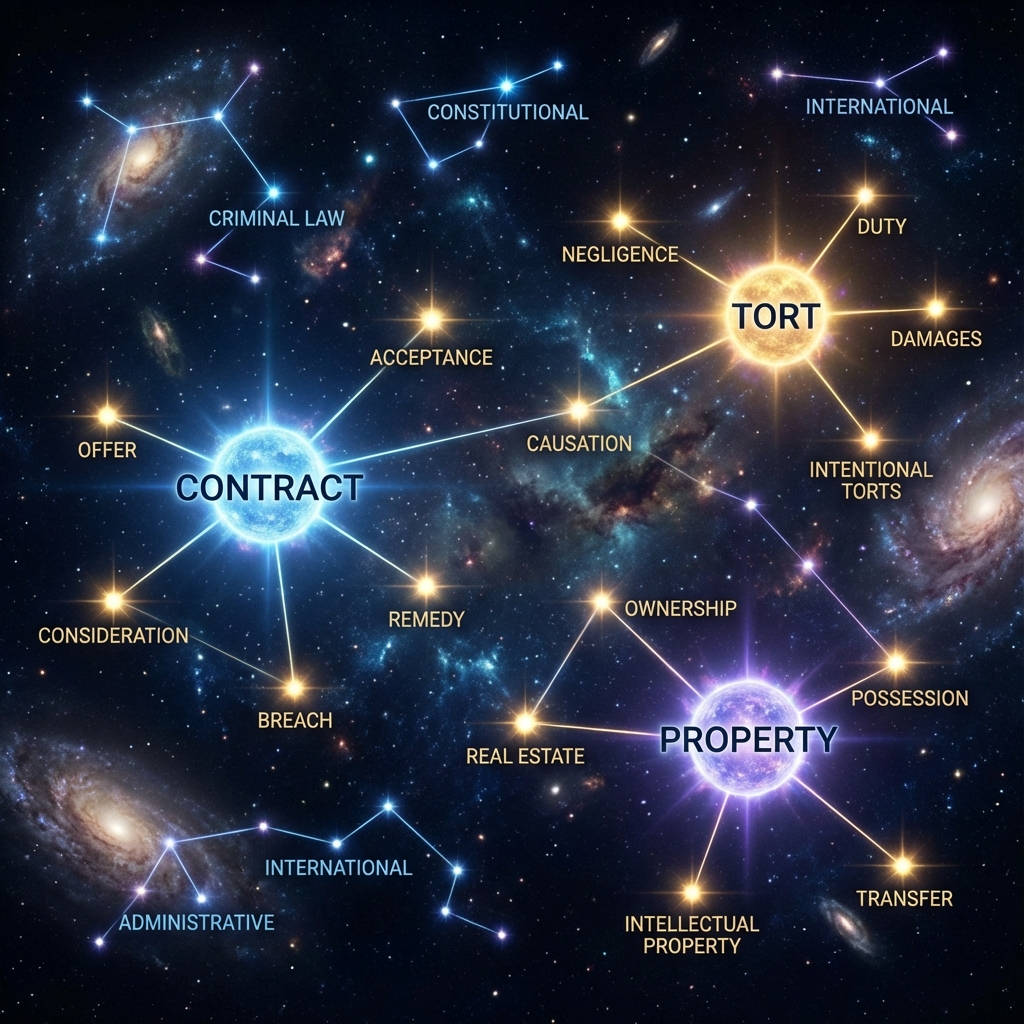
The legal universe is not a flat list of rules; it is a multi-dimensional web of authority. Statutes reference other statutes, which are interpreted by regulations, which are clarified by case law. Attempting to navigate this without a map is a recipe for error.
This post details our methodology for "Mapping the Legal Universe"—creating a navigable, computed structure of the law.
Key Concepts
A map of the law must capture more than just text; it must capture authority and direction.
- Statutory Extraction — The process of converting unstructured legislative text into machine-readable data.
- Cross-Reference Resolution — Identifying and linking every internal citation to its target, creating a traversable graph.
- Granular Indexing — Breaking massive statutes down to the sub-section level for precise retrieval.
Statutory Extraction
Legislatures publish laws as PDF or HTML text blobs. We parse these into structured objects. Every Section, Subsection, and Paragraph is given a unique ID and a home in the hierarchy.
This allows us to treat a specific provision (like "Section 2036(a)") as a distinct database object, not just a string of characters on page 45.
Cross-Reference Resolution
When Section A says "subject to the limitations in Section B," that is a hard dependency. Our system detects these links and creates a digital bridge.
If Section B is repealed or amended, the system alerts us that Section A is now potentially unstable. This impact analysis is impossible with standard text search.
Conclusion
We are moving away from the era of "Legal Search" and into the era of "Legal Computation." To compute the law, you must first map it.
By structuring the legal universe, we enable tools that can reason, audit, and predict, rather than just retrieve.
Frequently Asked Questions
How do you handle case law?
Case law is mapped as an edge connecting to the statute it interprets, adding a layer of "annotations" to the code.
Is this global?
Currently, we focus on specific US State and Federal domains to ensure maximum depth and accuracy.
How often is the map updated?
Legislative bots crawl state repositories nightly to flag changes for integration.
Sources & Further Reading
Read More Articles

How four specialized components turn complex legal rules into deterministic, client-ready documents using the Velcro Model of Law.
Read Article
Ontology as Infrastructure
Why a legal ontology is not a taxonomy, and why it must behave more like infrastructure than metadata.
Read Article
The Fact Pattern Epiphany
Why facts—not queries—are the true unit of legal reasoning, and what happens when you bind them correctly.
Read Article