Ontology as Infrastructure

In the rush to adopt "AI" in legal tech, a critical layer is being ignored: the ontology. An ontology is not just a list of words; it is the structural map of how legal concepts relate to one another. Without a robust ontology, AI is merely a parrot, repeating words without understanding their improved hierarchy.
This article explains why we treat ontology not as a feature, but as the core infrastructure of modern legal engineering.
Key Concepts
Building a legal brain requires valid connections, not just vast data.
- Semantic Rigor — The discipline of defining terms so they mean exactly one thing across the entire system.
- Hierarchical Stability — Anchoring concepts in a parent-child structure that survives changes in statutes or language.
- Infrastructure vs. Application — The distinction between the deep data layer and the user-facing tool.
Semantic Rigor
In a messy system, "Trustee" and "Fiduciary" might be treated as unrelated tags. In a rigorous ontology, "Trustee" is defined as a specific type of "Fiduciary" with inherited properties and constraints.
This rigor prevents the system from making category errors. It ensures that rules applying to all fiduciaries automatically apply to trustees, without manual duplication. This is the difference between a database and a knowledge graph.
Hierarchical Stability
Laws change, but the fundamental concepts of law evolve slowly. A robust ontology maps these stable concepts (Duty, Breach, Damage) while allowing the specific statutes attached to them to cycle.
By anchoring our system in these stable hierarchies, we build software that doesn't break every time a legislature passes a new amendment. The software understands the nature of the change, not just the text of it.
Conclusion
Software that deals with law must think like a lawyer, not a search engine. It needs to understand relationships, hierarchy, and category.
Ontology is the invisible infrastructure that makes intelligent automation possible. It is the difference between finding a document and solving a problem.
Frequently Asked Questions
Why not just use LLMs?
LLMs are probabilistic; law is deterministic. An ontology provides the guardrails that keep the LLM accurate.
Is this a standard?
We align with industry standards like SALI where possible, but extend them for deep substantive practice areas.
Does the user see the ontology?
No. The user experiences the accuracy and speed it provides, but the structure runs silently in the background.
Sources & Further Reading
Read More Articles

How four specialized components turn complex legal rules into deterministic, client-ready documents using the Velcro Model of Law.
Read Article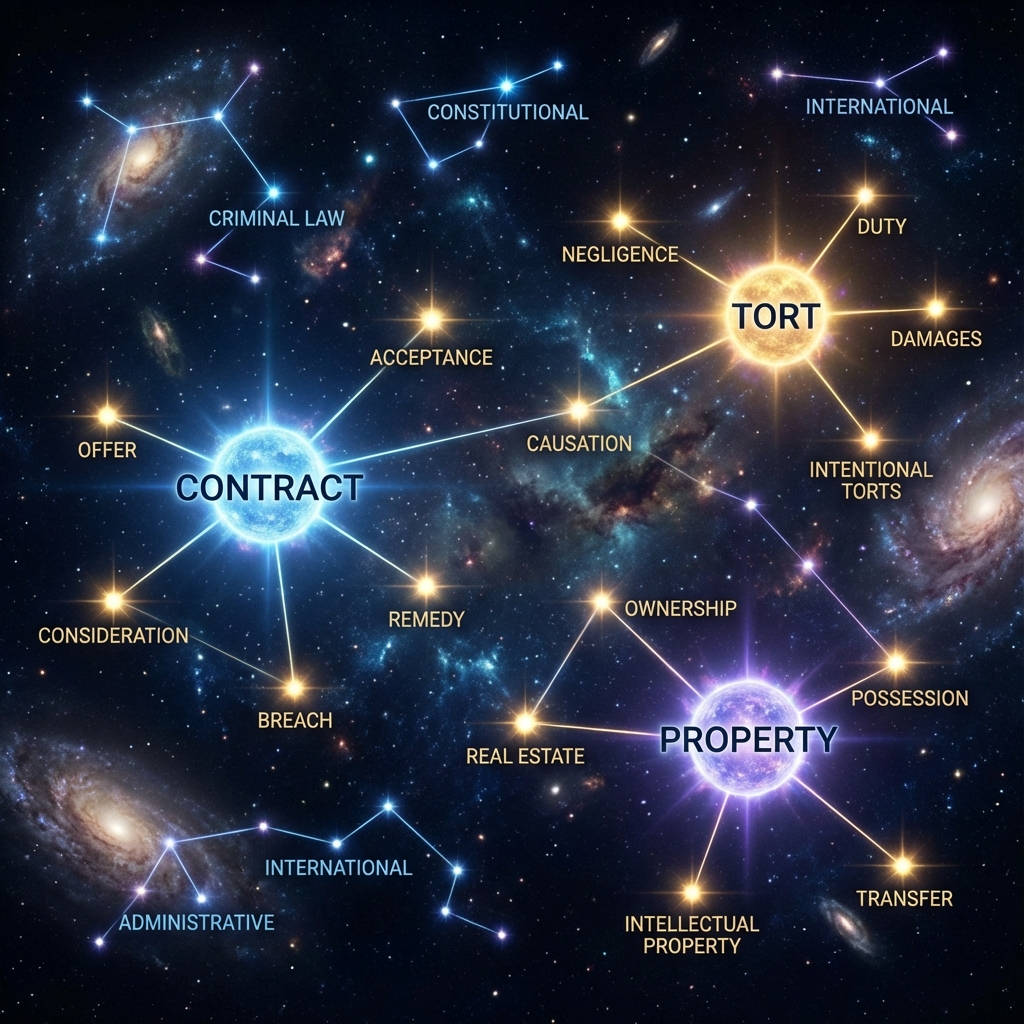
Mapping the Legal Universe
How we extract, filter, and map rules of law across statutes to build a navigable legal universe.
Read Article
The Fact Pattern Epiphany
Why facts—not queries—are the true unit of legal reasoning, and what happens when you bind them correctly.
Read Article